Saturday, June 19, 2010

You can have your cake and eat it too

I am currently in the middle of reading "The Black Swan" by Nassim Nicholos Taleb. The author talks about how a few unpredictable high impact events that underlie our lives. Just when you are convinced of the unpredictable nature of life, he advises not to stop predicting! Off course it all makes sense when he elaborates further and asks to continue forming opinion about future events that will affect your personal life on a smaller scale but avoiding unnecessary dependence on large impact predictions based on economic and social theoretic models.

This got me thinking (I know, always a bad sign...) about some other things that seem contradictory at first but seem to make sense once you delve deeper. Why is this important? Every pithy saying that I have ever heard makes sense only within a certain context and we can learn far more by examining the "flip" side and understanding how seemingly opposite viewpoints can co-exist.

You must have heard about Perfection being the enemy of Good Enough. If you haven't, just ask the folks who preach product strategy. Contrast this with my personal favorite advise to my kids: Almost Done is Not Done. Clearly achieving perfection is impossible for us mortals in quite a few cases; which means you have to be pragmatic in your decision making and not wait until eternity before you disclose your work to others. At the same time, you cannot make that an excuse to be sloppy or start watching Hannah Montana when your homework is almost done.

Being proactive is considered a good trait. In fact that is a crucial factor behind the success enjoyed by Spigit. We have built the leading social innovation product that pioneered several new concepts that now define this market. A lot of that success can be attributed to our proactive efforts. I built the product by combining my past experience with my intuition about what might work. In more scientific terms, I kept making S*** up and some of it stuck. When I look back at my experience in the last three years, it strikes me that equal share of our success came from reacting quickly and effectively to contingencies. It is certainly not good idea to be reactionary, but it is great to be opportunistic (something my co-founder really excels in). In fact that's a key message of the book "The Black Swan". You cannot really predict the next Black Swan event , but you have to be ready to take advantage of one when it happens.

The following stanza in Bhagavad Gita captures it's essence (at least according to me)

कर्मण्येवाधिकारस्ते मा फलेषु कदाचन।

मा कर्मफलहेतुर्भूर्मा ते सङ्गोस्त्वऽकर्मणि॥

Here's a loose translation: You have the right to your actions, but never to its result. Don't be attached to the fruits of your labor but at the same time don't let that detachment lead you to inaction.

Does that mean you should not have goals, stop being ambitious, cease to strive for excellence? What happened to "keeping your eye on the prize"? Even if you ignore or disagree with the deeper message about "detachment", there is still something to be said about focusing on execution without getting distracted by visions of glory that might follow. If a basketball player focuses completely on making that last second shot that will win the championship, he is more likely make it than if he is already thinking about the post-win celebration. A football receiver must first concentrate on catching the ball before he sprints to the end zone (that just about completes my quota of sports analogies for this year).

I will leave you with one last thought before I let you escape this prison of co-existing contradictions. Please remember that you can have your cake and eat it too, but you cannot eat your cake and have it too!

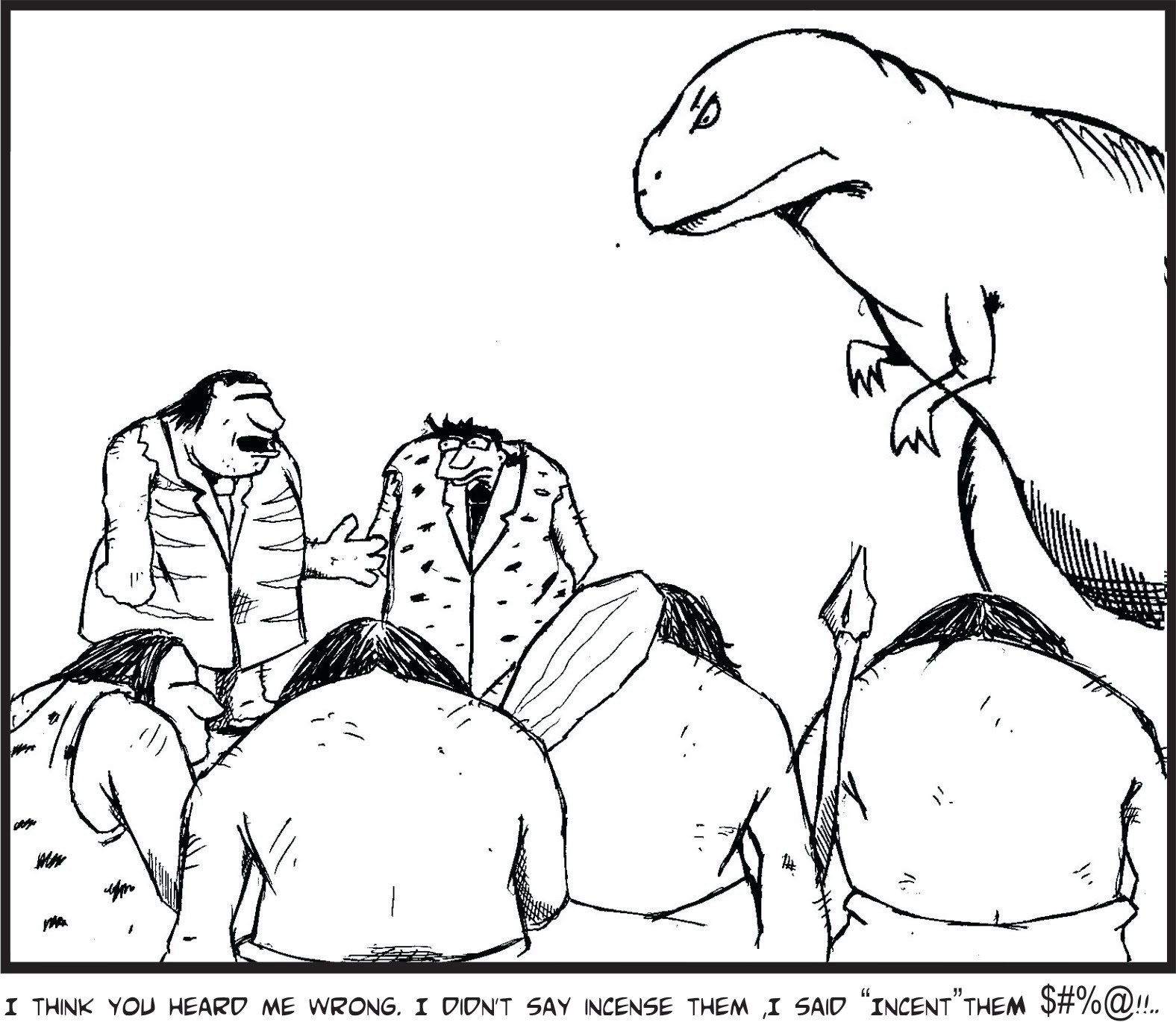
Acknowledgment: Cartoon illustrated by Milind Ranade who happens to be a good cook in addition to being a filmmaker and a cartoonist.

Saturday, June 12, 2010

Reputation on social innovation systems: how and why

I introduced the notion of user reputation within the context of social innovation platform via spigit's idea management system about three years ago. Judging by the growing list of competitors that are incorporating reputation in their products, its utility has certainly been validated beyond doubt. In this blog post I want to spend some time on the central idea behind the reputation score and why it is such a critical aspect of a social innovation environment.

What is Reputation Score?
Within a "purpose-built community", reputation score is an number representing the "quality" of user contributions measured against the stated purpose of that community.

I want to stress a few points here. First it should reflect the "quality" of contributions not the "quantity". I have talked to quite a few people and seen implementations that confuse reputation with "virtual currency" or "points". Although we have found a high correlation between active users and high reputation scores in practice, the score must not be computed based on the contribution volume.

The second point is that it should take into account how user is performing with respect to the community goal. For innovation communities this obviously relates to the quality of ideas suggested by a user. The figure below (grossly over-simplified but hopefully gets the point across) shows four factors that can potentially influence the reputation score:

  1. Peer Feedback - This perhaps is the most important factor influencing reputation. Peer feedback can be positive or negative. Depending on sponsor's preference, one can include purely social interactions such as making a connection or providing a testimonial, or take into account goal-driven interaction such as voting patterns or topical conversations.
  2. Achievements - User accomplishments in the context of the community goal is also an important factor. In social innovation system, it can be tied to the quality of ideas posted by a user as reflected by the stage advancement or acceptance ratio.
  3. Predictive Ability - At Spigit, we preach the value of involving the community, not just for idea collection, but for collaborative evaluation and selection of ideas. An individual's ability to spot good ideas early in their life-cycle is very important function of the system and therefore should be considered in reputation score calculations.
  4. Designated Status - This is similar to the notion of designating certain Web sites as "trusted" in certain web page ranking algorithms. Organizations always have certain individuals that have an "off-line reputation". Even if this does not automatically assign a higher score to a person, it can be factored in to control the degree of influence the person has on reputation of other users s/he interacts with.


Finally, the reputation score is really not a single number. Reputation scores can be attached to different segments of user contributions such as pre-defined categories, tags, ontological subjects, etc.

Putting Reputation Score to Use
Reputation score has three important uses. First it is a tool for bubbling up community leaders. Second, it can be leveraged to manage online behavior of community members, both positively and negatively. Third, it helps add relevance to idea ranking and reduces effect of gaming/clique behaviors.

Identify Emergent Leaders
A well designed Enterprise 2.0 platform must help in recognizing good ideas and good people. Reputation scores help identify "natural" leaders in the community as opposed to the "designated" leaders identified based on their position within the organization. Users that earn high reputation provide direct value via their knowledgeable contributions. They can also become part of community governance process. Community sponsors can rely on such users to channel user input in the right direction and spreading the word about new initiatives and ideas.

Reputation as a positive motivator
I discussed different types of motivations in another blog post. Reputation scores can be used as a powerful motivator directly and indirectly. Depending on the culture of the organization, being on the reputation leaderboard can be a source of peer recognition and bring out individual competition. We have seen this happen in communities that have a high percentage of knowledge workers. Some of Spigit's customers are also making this a basis for recognition by the leadership.

Inhibit spamming/gaming behaviors
This is one of the less known and less understood use of reputation score. A good reputation system should have the ability to detect behaviors that add little value to the community and correspond to spam-like content or deliberate attempts at gaming the system. For internal facing communities, such behaviors are rare (less than 0.5% of total user population). I have seen some external communities where the spam has drowned out legitimate content. These "bad apples" (as I fondly call them within Spigit platform) have to be detected and their reputation score and points need to be adjusted accordingly.

Saturday, June 5, 2010

Incentives DO work, monetary rewards may not!

You think incentives don't work? Here's the proof to the contrary.
  1. Assume that an action A is an incentive
  2. "A" by definition must "incite" users to perform the right type of action (check the definition in the dictionary)
  3. Incentives DO work
  4. QED
Alright I will stop being facetious and come to the point before you decide to boycott my blog entirely. I am always amused when people argue for or against "incentives and rewards". Incentives, by definition, must work, monetary rewards may not. The overwhelming feedback 400+ enterprise communities on Spigit platform is that you have to actively motivate community members to contribute. In other words, community members need different types of incentives to participate frequently and meaningfully. Monetary rewards work in certain contexts and promote behaviors that support the ideation process.

The central issue is not so much if (monetary) rewards work, but what you should be doing as a community manager to motivate the crowd. There are three dimensions to this problem: the motivational stimuli, personality types, and the context for ideation. Let's start with some answers to the fundamental question of what motivates people.


What motivates people to contribute on an innovation network?

Autonomy
Some individuals have the intrinsic desire to be creative and continuously strive to improve and innovate. Although a rare commodity, such people do exist and are at the core of every successful organization. As long as you don't create impediments in their work, this group does not really need outside motivating influences. They are happy to contribute as long as their ideas are seeing the light of the day and they get the freedom to be at the heart of the implementation process.

Recognition By Leadership
Organizational leaders are ultimately responsible for creating a culture that values innovation. Recognition from the leadership in such an environment is a great motivating factor for the community members. Recognition can certainly be demonstrated by public celebration of individual accomplishments but personal communication will work even better.

Recognition By Peers
Human beings are social creatures. Most of us seek and enjoy attention from people around us at home and in the workplace. If organizations create a culture that values innovation and make creative accomplishments widely known, it would provide a great motivation to contributing citizens.

Monetary Rewards
Money may not buy happiness but certainly helps achieve it in most cases. Effectiveness of money as a motivator depends on the relative worth of the award and how it correlates with achievements. Multiple strategies are possible ranging from fixed awards for being in the top list of contributors to awards that are roughly proportional to the ultimate value of the innovation.

Competition
Competition is a great motivator for people, something that is often ignored as an incentive that boosts participation. Competition can happen at individual level as well as a group level. Highlighting top leaders in terms of their virtual wealth or reputation is a way of encouraging individual competition. Aggregating ideation and collaboration statistics at geographic location, divisions, job functions, departments, etc. can spur a group level competition.

Personality Types on Innovation Networks
The second factor in solving the incentive puzzle is different types of personalities that contribute to the innovation process. I have observed the following types on Spigit's innovation networks.

  • Ideators - Users with original ideas. Note that "ideators" may not necessarily "innovators" in the sense that people with great incites or novel solutions may not carry the idea through to working innovations. That typically happens via collaboration among many personality types.
  • Co-Creators - Individuals that collaborate to improve upon the original idea. Dynamic team formulation is a must for any social innovation environment. In fact an idea will not achieve enough escape velocity without a team that evangelizes it and explores feasible ways of implementing that idea.
  • Mavens (term I borrowed from "The Tipping Point") - Every organization has people who are experienced or simply curious enough. These individuals have amassed considerable knowledge that can be very useful to ideators and co-creators. Leveraging maven contribution requires making them aware of ideas in their sphere of expertise and motivating them to share their knowledge with the rest of the community.
  • Connectors - Making the right connections between ideas and people becomes very important within large communities facing the "long tail" problem. There are a few individuals within any social network that frequently communicate with a broad range of community members and therefore provide a natural mechanism for bringing together ideators, co-creators and mavens.
  • Cheerleaders - Community members that provide positive feedback and encouragement to other users. Whether cheerleaders need to motivated is debatable. Cheerleading in excess can become spam that detracts collaborators from central topic of conversation. On the other hand, I have observed that they keep the dialog going in many cases and motivate users that may be somewhat reluctant to share their ideas and viewpoints in an open forum.
Ideation Context
The innovation context is shaped by a number of factors but two stand out the most: the ideation framing and community composition. In general we advocate creating an always-on ideation environment that offers multiple ways in which the ideation is framed:

  • Continuous Open Innovation - This model can either provide a completely open forum for blue ocean thinking or provide a gentle direction by spelling out broad strategic objectives. In general this type of community should be encouraged to submit horizon 2 or horizon 3 ideas. This format is too inefficient for incremental innovation.
  • Innovation Themes - Theme-based ideation can provide a focus and lightweight direction for open innovation forums. In fact we encourage Spigit clients to introduce themes that change periodically in order to create a dynamic environment for ideation.
  • Ideation Campaigns - Companies often engage a segment or all of their business community members in ideation campaigns that run anywhere from a few weeks to few months timeframe. The ideation campaigns are focused events that either invite innovative solutions to a well defined problem or ideas for incremental improvements leading to new product features, process efficiencies, or cost savings.
Community composition is the second important aspect of ideation context. In pharmaceutical and tech companies, the community tends to have a much higher percentage of knowledge workers due to the nature of their business. On the other hand, retail sector companies are at the other extreme. Retail industry also has a highly transient, younger workforce that has significant seasonal variation.

So how do I choose the right incentive?
The right incentive, or I should say the right mix of incentives, depends on the particular combination of personality types and contextual parameters described earlier. I have observed that in more sophisticated domains with high percentage of knowledge workers, peer recognition and individual competitive element work very well for co-creators, mavens, and connectors. If a community runs a focused campaign/competition, members expect some type of monetary reward at completion especially in external facing communities. Smaller monetary rewards tend to work for less sophisticated domains. In this case, care has to be taken to highlight and reward quality contributors otherwise the reward scheme often leads to a lot of spam.

You can certainly perform analysis on the type of innovation network you are managing and characterize it in terms of personality type and contextual elements. This will give you a starting point for setting up a mix of incentives that should work for that combination. Ultimately there is no substitute for actively monitoring the effects of your incentive schemes and changing the mix that yields the right motivation for each type of person in your community.

Monday, May 31, 2010

World Innovation Convention 2010, Ibiza, Spain

I had fairly interesting three days participating in the World Innovation Convention in Ibiza, Spain. In the beginning I thought it was too small a gathering, but it turned out to be a blessing. I had a chance to discuss many innovation related issues at depth with attendees from Nokia, Thomson Reuters, Microsoft, and Shell among others.

The first day began with a keynote by Prof. Deschamps in which he drilled down into the concept of "innovation leadership". Some of the interesting points that came out of that were:

* Innovation leaders do not necessarily have to be innovator themselves
* Two different styles of leadership, more creative exploratory front end leaders and execution oriented backend leaders that will get your innovation faster to the market
* Enemies of successful innovation - arrogance, complacency, greed (now the last one is quite interesting!)
He touched upon the notion of top down and bottom up styles of innovation. In his view radical innovations that change business models would have to be done top-down whereas incremental innovation is suitable for bottom-up innovation. My view is a little different. I think any type of innovation, there has to be synergy between the gathering of ideas whether they come from the leadership or from the average Joe and the leadership team that ultimately makes final decisions. So a radical, business model changing idea could come from a grass root, open ended innovation exercise in a truly bottom up manner. The difference would be in the scale and the leadership level at which it will get evaluated, selected, and implemented.

I gave my ending keynote on the second day. I mainly talked about the idea of democratizing innovation, why there is a surge in companies wanting to do this, strategies for executing this bottom-up approaches, and some observations about how companies go about doing this. The message was to move away from insular innovation to a more transparent and open model.


We heard a series of presentations, mainly by employees leading innovation in their companies in some capacity. Some described efforts that started at the top (e.g. Amanda West, Chief Innovation Officer of Thomson talked about their incubation program), some were about individuals leading the charge via specific projects and initiatives (Ron Exner from Kraft Foods talked about innovations in packaging and the process of taking those innovations from R&D to production).

Open Innovation
Companies are increasingly keen on collaborating with other companies as well as individuals outside the company. The main reason for collaboration with other companies is to take advantage of their respective core competencies to quickly bring new products to the market. P&G's collaboration with Dunkin Donuts is a good example of this where P&G combined their expertize in supermarket distribution channels with the unique brand of coffee produced by Dunkin Donuts. Coke's collaboration with illi on coffee products is another.

Collaboration with customers or individual innovators is often done to support incremental product improvements, but some time also done to create new products based on innovative ideas suggested by customers or individual innovators. Customer feedback sites like Dell's IdeaStorm are a well known example of the former. Martin Ertl from Bombardier talked about co-creating railroad technologies (e.g. improved car designs) via customer competitions which also fits within the first category. P&G's "Connect + Develop" and Shell's "Game Changer" initiative illustrated the later. Micheal Ruggier from Shell gave a good example of an innovation that results via such collaboration: a device for measuring 3-phase flows created by applying body scanning technology found in medical devices.

Internal Innovation
A number of speakers (Philips, Kraft Foods, BASF, Thomson Reuters) talked about traditional innovation processes that originate and managed in a top-down manner. Most of these were in industry segments that rely on complex technologies to create value and therefore inherently rely on subject matter experts to create and deliver innovations. Most companies have a system of evaluating emerging trends and inferring key strategic innovation areas that should become the focus for their R&D efforts. Coke, for example, identifies the "Need States" and pairs that with demographic factors to get insights into unmet market needs as well as drive product marketing.

Surprisingly there was relatively little discussion on employee-driven innovation except in two cases. Hannes Erler from Swarovski gave a very good overview of their innovation process. Swarovski creates upwards of 1300 products every year and benefits tremendously from suggestions posted on their on-line idea management system. Novartis presentation mentioned "Innovation Oscars" but did not provide much detail.

Going Green
Green technology was definitely a hot topic. Prof. Markku Wilenius talked about Kondratieff cycles as measured by 10 year yield on S&P 500. The current downturn is unique in the extent to which it is affecting the entire world. The major challenge in coming out of this economic cycle would be the balancing act between increased human demand for resource consumption and lowering ecological impact of future development. It was interesting to hear technologies developed in this direction including oil spill containment, eco-friendly cars, and electronic printing technologies.

Innovation Measurements
I heard a few interesting thoughts about measuring results of innovation process. Shell's Game Changer program converts roughly 1% of submitted ideas into working products. Dr. Martin Curley mentioned that success rate of innovation is 5% although the source of this information was not clear. Bombardier presented an interesting way of characterizing the value of socializing innovations. He provided statistics on the "value" provided by users participating in their YouRail contest. He computed that value based on the money the company would have spent to have their employees engage in a similar collaborative innovation effort. The calculation was done by mapping hours spent on the competition sites, page views, and number of designs produced by the community.

Sunday, May 30, 2010

Are you smarter than a sixth grader?

I recently finished coaching a team of middle-schoolers competing in the Odyssey of the Mind (OM) tournament. My team was working on building a set of balsa wood columns designed to maximize supported load given a set of weight and distribution constraints.
The unique feature of the OM competition is its emphasis on letting kids solve the chosen problem completely on their own. A coach is not allowed to make any decisions for the team, nor is he allowed to offer preferences or direct solutions to the problem. This makes coaching extremely frustrating at times (Three points in space defines a plane, so if introduce a fourth point that makes the system unstable. Can't you see it?). On the positive side, I looked at the whole process as a lab experiment about how humans (well ok a bunch of sixth graders - pretty close) collaborate to solve an open ended problem subject to time, resource, and monetary constraints.

As expected I observed plenty of things that could have been improved upon, but I also saw a few "best practices" that can be followed when grown ups like me and you are collaborating within a social network. I am posting some of my observations as a question to the readers. Unfortunately you don't win million dollars if you have all the right answers. On the bright side, if you fail you get to post a comment on this blog that says "My name is [insert your name here] and I am not smarter than a sixth grader!


Are you employing the right information aggregation mechanisms?
My team had to select five members out a total of seven to compete in the "sponteneous" section of the competition. I am not sure about the rationale behind forcing the team to select a sub-group in this manner but I am guessing they do it to test the collaboration spirit. For us it proved to be a daunting task given different combinations of personal preferences, desires, gender conflicts, etc. Ultimately the team decided on a voting model that involved each kid writing in five names for three possible variations of the sponteneous problem. After everyone cast their ballots, we simply selected the top five vote getters in each of the three possible variations of the problem. Amazingly, the team collectively seemed to have made a better choice than most of the team selections proposed by each team member individually.

Selecting the right aggregation model is crucial to the success of collaboration communities. In general the end goal of these models is creating a ranking of competing entities such as people, ideas, outcomes, best practices, etc. Spigit offers a number of aggregation mechanisms including:
  • Polls - very simple mechanism for analyzing crowd preferences
  • Prediction Markets - determine likelihood of future outcomes
  • Idea Markets - Allows users to invest virtual money on ideas and in the process ranks ideas according to their potential
  • Automated Graduations - Engages the crowd in idea filtering by aggregating information about buzz, voting, reviews, team memberships, etc.

Is your community composed of a diverse, independent-minded individuals?
Our OM team required different kinds of talents to be successful. Some team members were good at column designs, some were good at building, and some were good at writing and acting. It also turned out that the roles and contributions changed as we went along. Initially boys on the team were keen on building and the girls were engaged in writing/acting aspect of the problem. These roles and interests changed over a period of time as the kids discovered some hidden talents that they didn't know they had.

The evolution of the OM team is fairly representative of what we see in the 400+ communities that are supported on the Spigit platform. When you expose the ideation process to a large number of participants with diverse skill sets and experiences, it greatly speeds up the innovation process. If implemented correctly, individual biases tend to cancel out. Community members are quick to point out flaws based on their experience and jump in to greatly enhance the idea's potential. In some cases, we have seen bad ideas turned into very good possibilities when users suggest a different use case for the same basic concept. Great ideas are often suggested by users that happen to be interested in areas out of their "designated" expertise or users who are close to the customer.

Are you encouraging an open ended exploration of the solution/idea space?

When our team started tackeling the column design problem, I explained the physics behind column building process. I talked about truss designs, different types of forces, failure modes, etc. The kids did take some hints from that explanation, but very quickly started experimenting with different design possibilities. It wasn't quite the linear process one adopts in solving text book problems. They created 50+ column models that included different cross-sections, truss patterns, laminations, etc. The team then tested more promising ones and ultimately selected a design that was best in terms of the supported weight and stability.

This exploration strategy reminded me very much of the way bees decide on the best source of nector as described in James Surawieki's "The Wisdom of Crowds" book. The most exciting thing about social innovation is how the crowd can collectively break the mold and come up with ground breaking ideas and solutions via taking random walks through the solution space. Traditional R&D centric approach tends to perform poorly in this area. Tools like spigit offer communication efficiencies that scale very well and enable this approach. In conjuction it is important to encourage open ended thinking. Radical ideas may be adversely reviewed by the peer network, but sponsors should be careful not shutting down those ideas before the owner has a chance to prove the critiques wrong.